.png)
CLAMS
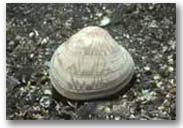 |
Taxonomy Phylum: Mollusca Class: Bivalvia Order: Veneroida Family: Veneridae |
 |
Distribution
Butter Clams |
Common in protected beaches in bays and estuaries along BC coast. |
Littleneck Clams |
Common in protected beaches in bays and estuaries along BC coast, and near rocky outcrops on outer coast. |
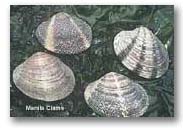
Manila Clams |
Exotic species; common in protected beaches in bays and estuaries in Georgia Strait and west coast of Vancouver Island; small isolated populations in Queen Charlotte Strait and around Bella Bella. |
Razor Clams |
Occur only on surf-swept beaches in Long Beach region on the west coast of Vancouver Island and on beaches east of Masset on the northeast coast of Graham Island in the Queen Charlotte Islands. |
Surf Clams |
Surf clams are found in the Atlantic, Pacific and Arctic oceans, as well as in the Gulf of St. Lawrence. In the western Atlantic, their range begins near Baffin Island and extends south to Rhode Island. In the Pacific, they are distributed from Puget Sound, Washington, north to Alaska and across the Bering Sea to Asia, where they range from Siberia to Japan. |
Varnish Clams |
Varnish clams first showed up on British Columbia beaches in the early 1990s, and quickly spread to Washington. It is likely that they were introduced into North America via ballast water. Varnish clams are now commonly found in most areas of Puget Sound and Georgia Straight. |
Habitat
-----------------------------------------------------------------------------------------------------
 Butter Clams:
Variety of substrates but typically occur in beaches of porous sand, broken shell, gravel and mud; may occur in association with littleneck clam; burrow to a maximum depth of 25 cm; planktonic larvae are dispersed by currents; adults remain in same burrow for life.
---------------------------------------------------------------------------------------------------------
Littleneck Clams:
Firm, gravel beaches; often in association with butter clam; burrow to a maximum depth of 15 cm, but usually 3-8 cm below surface; planktonic larvae dispersed by currents; adults remain in same burrow for life.
---------------------------------------------------------------------------------------------------------
Manila Clams:
Sand-gravel beaches; burrow just below surface, to maximum depth of approximately 10 cm; planktonic larvae dispersed by currents; adults remain in same location for life.
---------------------------------------------------------------------------------------------------------
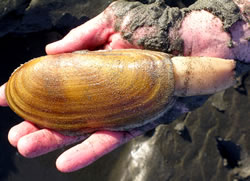 Razor Clams:
Sandy, exposed beaches; usually burrows from just below surface to a depth of 25 cm; can burrow to depths greater than 60 cm in less than a minute; planktonic larvae dispersed by currents; do not form permanent burrows.
---------------------------------------------------------------------------------------------------------
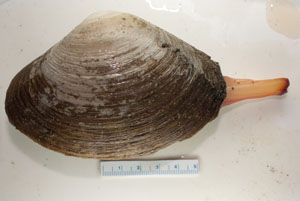 Surf Clams:
Surf clams live in ocean areas with sandy bottoms in which they can burrow.
---------------------------------------------------------------------------------------------------------
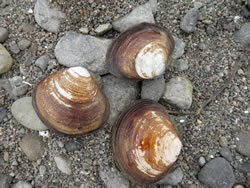 Varnish Clams:
They are particularly abundant near fresh water inputs. They are oval-shaped and flattened, with a shiny brown coating (periostracum) on the outer surface of the shell; the interior of the shell is purple. Varnish clams are typically found buried deeper in the substrate than either Manila clams or native littlenecks. Unlike most other local clams, which are filter-feeders, varnish clams are both filter-feeders and deposit-feeders.
____________________________________________________________________________________________
Tidal Elevation
Butter Clams |
Lower third of intertidal zone; may occur to 15 m subtidal depth |
Littleneck Clams |
Slightly above mid-intertidal to subtidal; may occur to 12 m subtidal depth |
Manila Clams |
From 1 m intertidal zone to well above mid-intertidal level; does not inhabit subtidal; limited spatial competition with native clams. |
Razor Clams |
Mid-tide level to 20 m subtidal depth. |
Surf Clams |
Intertidal zone to about 100 metres. |
Varnish Clams |
Upper third of the intertidal zone. |
Growth Rate
Butter Clams |
Slow; sexually mature at 38 mm (about 3 yr.); legal size of 63 mm is reached in 5-6 yr. in Strait of Georgia, 7-8 yr. in Alert Bay and after 9 yr. in north coast. |
Littleneck Clams |
Slow; sexually mature at 25 mm (about 2 yr.); legal size of 38 mm is reached in 3.5 yr. in Strait of Georgia and 5-6 yr. in north coast. |
Manila Clams |
Slow; sexually mature at 20 mm (about 2 yr.); legal size of 38 mm is reached in 3.5 yr. in Strait of Georgia and 5-6 yr. in north coast. |
Razor Clams |
Variable, fastest at lower beach levels; sexually mature after 1 yr. in south and 3 yr. in north; minimum legal size of 90 mm is reached in 1-2 yr. at Long Beach and 3-4 yr. on Queen Charlotte Islands; largest and oldest clams found in BC are from Queen Charlotte Islands. |
Surf |
They grow to a maximum length of about 150 millimetres, but typically are between 75 and 130 millimetres. They are long-lived-it is believed that some unharvested populations regularly reach 40 years of age. |
Varnish Clams |
Varnish clams can grow to about three inches in size. |
These shellfish are found on intertidal beaches of mixed sand, gravel, and mud. Except for the larger butter clams, rakes are usually most effective for gathering clams and cockles, and are less damaging to the clams and the beach. Butter clams are normally buried between 8 to 14 inches deep, requiring the use of shovels or digging forks.
Source: Fisheries and Oceans Canada