.png)
Information & facts
Species Name
Pink Salmon
(Oncorhynchus gorbuscha)
Common Names
Humpie, humpback salmon
Size Range
3-5 lbs, up to 12 lbs
Description
Male pink salmon develop a large hump on their back during spawning, hence the nickname humpback salmon. This is the smallest of the fall-spawning Pacific salmon. On the BC mainland, pink salmon runs only occur in odd-numbered years.
Spawning
Pinks use the mainstems of large rivers and some tributaries, often very close to saltwater. Because their fry move directly to sea after emerging, the closer they spawn to saltwater the better. The shorter journey reduces predation and increases survival. Sometimes pink salmon spawn right in saltwater, avoiding freshwater altogether. 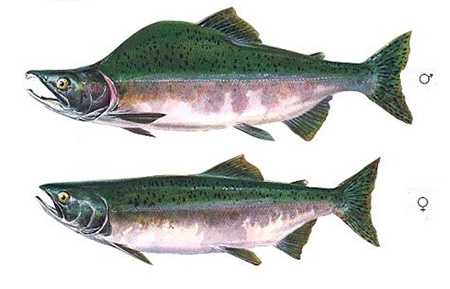
Pinks have a very regular life history, living for two years before returning to spawn the next generation. This is why pink runs in BC only occur every other year; there are no one-year-old or three-year-old fish to establish runs in the other years.
Rearing
Pink Salmon have a 2 year life cycle, after they hatch they start there journey to the ocean immediately and always return to the spawning rivers in 2 years. Because of this there are odd year or even year rivers of Pink Salmon fishing. In the sea, young pink salmon feed on small crustaceans and plankton, shifting their diet to include shrimp-like crustaceans and fishes as they grow. Other foods include mussel shrimps, crayfish larvae, barnacles, tunicates and insects.
As mentioned, pink fry do not rear in freshwater. Immediately after emerging they move downstream to the estuary and rear there for several months before heading out to the open ocean. Because of this, pink fry have no spots, which provide camouflage in streams, but are bright chrome for open water.
How to fish for Pink Salmon
When Pink Salmon are retuning to their rivers to spawn they tend to hold at the river mouths, bays, and estuaries close to the spawning rivers. Pink Salmon can hold for several days to a couple of weeks, depending on water levels in their spawning rivers. Pink Salmon also tend to hold close to shore which offers fishermen a chance to beach fish for them or fish from small boats close to shore. Most of these returning Pink Salmon are 3 to 5 pounds. Pink Salmon can offer a good fight on light tackle. Both Fly fishing and spincasting are productive methods of fishing for Pink Salmon.
When fly fishing for Pink Salmon use a 9 or 10 foot 5 or 6 weight fly rod with matching reel spooled with 5 wt or 6 wt WF sinking tip line and 9 to 12 feet of 8 lb test leader or 2X tippet. Pink Salmon will only take a selective few flies such as the small pink and silver flies like the Pink Eve, in long shank sizes of from #6 to #2. Whatever fly pattern you use it should incorporate pink and silver or flash with the fly material being on the sparse side. Pink Salmon will actively take a slow stripped pink colored fly.
Pink Salmon take flies with a soft strike but noticeable if you are slowly stripping the fly line over your index finger. Lift the rod tip at the strike and the pink will set the hook itself as it turns to follow and remain with the school.
If spincasting for Pinks use a light to medium spincasting rod that is about 7 feet long with a matched spinning reel spooled with 8 to 12 pound line with a small pink and chrome spoon or spinner attached. Fly fishing for Pink Salmon is usually more productive than spincasting for them but spincasting does work.
Pink Salmon Fishing Tips, Tricks and Tactics
- Sharpen those Hooks – Salmon have a thick jaw that can make setting a hook more difficult. You’ll want to make sure that your hooks are razor sharp when fishing for salmon. We recommend using the Gamakatsu Barbless Octopus Brand. You must use single barbless hooks when fishing for salmon in British Columbia, its the law.
- Overcast for Success – Salmon prefer low lighting conditions, thus making days with an overcast more successful for salmon fishing than other days. In addition to overcast days, dawn and dusk provide optimal light conditions for salmon. You can still catch salmon on bright sunny days but they will be in deeper water and slightly less active.
- The Best Lure for Pink Salmon – For artificial lures; we recommend using pink and chrome flies, spinners or small spoons but jigs work well also. The key to success is to use a slow retrieve.
- Learn to Spin Cast – One of the most up and coming methods for fishing for pink salmon is spin casting. This is useful for both river and saltwater fishing from either boat or shore for pink salmon, you basicaly cast your lure out and slowly reel it back in where you think salmon are. Fly Fishing is also a popular up and coming method for fishing for Pink Salmon.
- Get the Stamp – To catch and keep salmon in BC you’ll likely need a special stamp or permit along with your fishing license. It’s important to have this to prevent you from getting a large fine. It’s also important because the cost of the stamp/permit is used to fund salmon stocking and conservation programs.
Additional Resources on Salmon Fishing
Hopefully my goal to make you a better salmon fisherman was achieved with the information you gained reading this section. However, you may still want or need to research other sources to improve your salmon fishing skills. That’s why I put together the below resources, they provide additional information on fishing for salmon and may also help improve your angling skills.
- Float-Fishing for Salmon & Steelhead – If you’re interested in float fishing then this is the perfect book for you.
- How to Catch Salmon, Sturgeon, Lingcod, Rockfish, and Halibut: Along the Pacific Coast - Packed with no-nonsense information on behaviors and best methods & equipment for catching more salmon, rockfish, lingcod, sturgeon, and halibut.
- Salmon – Wikipedia – Get more scientific information on salmon at Wikipedia.org.
- IGFA All-Tackle Fishing Records – Visit the International Game and Fish Association website to get more salmon fishing records and/or fishing records for other types of fishing.