.png)
Information & Facts
Species Name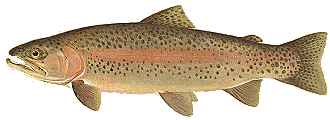
Rainbow trout
(Oncorhynchus mykiss)
Common Names
Bow, Redband, Silver Trout, Redsides
Size Range
Average 11-18 inches. Rainbow trout can grow to 20+ inches in quality populations.
Description
Rainbow trout are the most common and hence most popular species of trout in BC. There are thousands of wild populations provincewide but the main reason for their popularity is that the Freshwater Fisheries Society with the Provincial Government stocks millions of rainbow trout in hundreds of waters annually across the province for the specific purpose of providing recreational angling opportunity. Rainbow trout are an excellent game fish reputed for their willingness to bite bait and lures, scrappy nature when on the end of a fishing line and the fact that they are excellent table fare. Rainbow trout can be identified by their bluish-green back, silver sides and belly, and black spots on the body and on the caudal, dorsal, and adipose fins. Another characteristic of rainbow trout, and a characteristic that it gets its name from is the presence of a reddish stripe along its sides that is often, but not always present. There are three subspecies of rainbow trout that occur in BC.
Generally people think of rainbow trout as only inhabiting cold clear rivers, streams and lakes but subspecies can be anadromous (sea going). Anadromous rainbow trout are commonly known as steelhead. Steelhead are also highly regarded game fish.
Where to fish for Rainbow trout
Rainbow trout can be caught in every region in BC and so are in a lake or stream near you. They prefer cool, clean water (less than 70°F) that is well oxygenated.
How to fish for Rainbow trout
Rainbow trout prefer to eat small aquatic and terrestrial insects, but larger adults will also prey on other fishes. Part of their popularity as a game fish is because they are so willing to take a variety of baits, both natural and artificial, including but not limited to: corn, salmon eggs, dough, cheese, night crawlers and powerbait. Artificial lures such as spinners, spoons, jigs, flies, wedding rings and plugs are also very effective. When fishing lakes during the spring and fall, the water is cooler and the rainbow trout will often be found near the surface and also more active. Trolling with spinners, flies, and spoons is a common tactic as well as suspending bait from the surface. When the water warms during the summer months, the rainbow trout become a little more sluggish and seek deeper, cooler water, so fishing will need to occur at or near the bottom. To catch the bottom dwellers you will want to fish with bait slightly suspended off the bottom, or troll with your lure near the bottom as well.
Trout Fishing Tips, Tricks and Techniques
Ok, we’re pretty sure you came to this page for our amazing Rainbow Trout fishing tips. You can find these tips below. They were put together by our team who researched them and then tested them out in the field. We hope they are as effective for you as they were for us!
- Know the Current – If you understand how a river or stream is shaped by moving water you’ll be able to find trout very easily. Deep pools created by the current can hold a big trout, but smaller trout can also be found in them. The large trout will most likely be in these pools during dawn and dusk.
- Choose Your Lures Wisely – It’s really important to pick the right lures. Using the wrong type could make you miss out on opportunities. For optimal performance, we recommend the Panther Martin Spinning Lures.
- Power Bait ONLY Works on Stocked Trout – If you’re fishing for trout with powerbait then you better make sure the trout in that body of water were stocked (farm raised) and not native. Native trout will not bite on Powerbait, the only reason stocked trout will is because they are fed pellets in the hatchery and will eat anything that resembles or smells like the pellets.
- The Best Live Bait – Hands down night crawlers are an effective live bait for catching trout, along with minnows and crayfish. A neat trick is to take a look at what lives on the shore of where you’re fishing for trout and see what might be native to their lunch or dinner menu. Mayflies, when native to the area, can be deadly during the fall season.
- The Silver Spoon – Trout, especially lake trout love to bite on a small silver spoon. The best way to use this to your advantage is to buy a lure that mimics a spoon. Our top choice is the South Bend Kastaway Trophy Spoons.
Additional Resources for Trout Fishing
Hopefully the information provided on this page will make you more successful at catching trout. However, you may still want to expand your research on trout fishing and look into additional resources. That’s why we’ve provided you with additional places below where you can learn more about trout fishing. If you found our trout fishing tips useful then please share our website with your fellow anglers, friends, family and co-workers.
- Trout Support – The best online training videos available for catching Trout. Learn how to fish like a tournament pro.
- Fishing Records – IGFA – Get real-time information on trout fishing records and records for all other types of game fish.
- Trout Legend – Forum – A great community of fishermen who love to catch trout. This is a great place to meet other fishermen interested in trout and other types of game fish.
- Trout – Wikipedia – Learn more about the different species of trout and get specific information about each species.